Home Page › Forums › History and Doctrine Discussions › Good Article in Defense of BoA
- This topic is empty.
-
AuthorPosts
-
December 4, 2012 at 4:27 pm #258798
Anonymous
GuestThe papyrus printed in the PoGP is of an extremely common variety. There’s nothing unusual about it. December 5, 2012 at 12:06 pm #258799GuestSamBee wrote:The papyrus printed in the PoGP is of an extremely common variety. There’s nothing unusual about it.
Do you mean facsimile 1?
I’d be interested in seeing similar images. I’m not going to do a MDDB style ‘CFR’* on you but I’ve heard this claim on critical sites before, but never seen other pictures. As said, I don’t consider it case closed.
(*Mormondialogue.org posters shout ‘CFR’ or ‘call for references’ when they want to see evidence for a claim)
December 5, 2012 at 4:15 pm #258800Guest
[img]http://upload.wikimedia.org/wikipedia/commons/9/90/Vignette1.jpg [/img] The mistakes are coincidentally exactly where the missing portions are.
The pots underneath the table are obviously the pots in which mummified organs are put.
This is without discussing what the hieroglyphs mean.
December 6, 2012 at 2:09 am #258801GuestI’m aware of the refound facsimile and the gaps. But you mentioned ‘lots like it’ – but I’ve never actually seen one. Do you have any examples of comparable pictures? I’d be interested in seeing them. The ‘mistakes’ in filling in the empty space are un-provable because no-one knows for certain what was originally there.
A few thoughts on facsimile 1:
– Bits are missing (laconai). We don’t know when the damage happened. There are contemporary descriptions of the facsimile which reference the knife (one of the supposed drawn in parts).
– Although there are other copies of Book of Breathing (which the facsimile is believed to come from), none of them contain a scene that is identical to facsimile 1. Some differences exist.
http://en.m.wikipedia.org/wiki/Joseph_Smith_Papyri – We have some of the fragments Joseph owned. We don’t have all of the papyri that were actually owned.
Don’t get me wrong. I’m not some blinkered apologist. I’m suspicious of the BoA’s origins. But consider it to not yet be proven false.
December 6, 2012 at 4:21 pm #258802Guestmackay11 wrote:I’m suspicious of the BoA’s origins. But consider it to not yet be proven false.
What if the papyri were catalysts for a visionary experience and/or channeling – spirit writing. Then what is actually on the papyri would be irrelevant. The actual content of the BOA could then be evaluated on its own merits. The question of historicity would still stay unknown, but those in favor of historicity would be firmly in faith/hope territory and not hanging their hat on questionable artifacts.
The more I look, the more it seems visionary experiences account for much of what I at one time believed to have been physical events (first vision, Moroni visits, 15 witnesses, returning the plates to a cave stuffed with records). Of course that is the way confirmation bias works, we start with a conclusion and the more we look the more evidence we find to support our conclusion.
I might also add that visionary experiences don’t explain everything. Emma says that she lifted the covered plates to clean (I wonder what would have happened had she sneaked a peak – would Emma have turned into a pillar of salt or something? I would have totally looked!), others have described the Nephite interpreters. Where did these physical items come from? Perhaps, they came mostly from ancient artifacts (like Zelph arrowhead, the greek psalter, the papyri, Masonic rituals, etc.) with a few modern creations sprinkled in (Kinderhook plates).
My point is that there do seem to be some physical items, but in cases where we still have these items – the relationship between the items themselves and the revelations that sprang forth from them appears to be quite limited. Perhaps limited only to being a catalyst for a visionary experience and/or channeling – spirit writing. With this view, the catalyst item could have been a rusty doorknob and it wouldn’t matter.
December 6, 2012 at 6:17 pm #258803GuestQuote:What if the papyri were catalysts for a visionary experience and/or channeling – spirit writing. Then what is actually on the papyri would be irrelevant.
This the only viable answer… but it puts it into the category of the Book of Moses.
Quote:But you mentioned ‘lots like it’ – but I’ve never actually seen one. Do you have any examples of comparable pictures? I’d be interested in seeing them.
These two are fakes, or reconstructions, but show several similarities –

[img]http://www.touregypt.net/images/touregypt/dead1.jpg [/img] 
[img]http://www.crystalinks.com/bookofdead.jpg [/img] 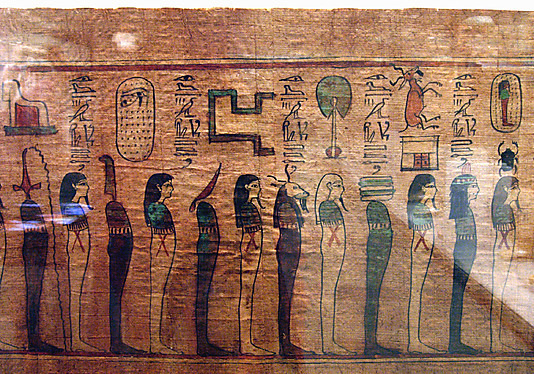
[img]http://images.metmuseum.org/CRDImages/eg/web-large/vs30.3a.jpg [/img] 
[img]http://cescjie.satriapajak.com/medium/9/Papyrus%20lion’s%20head%20Flowers9.jpg [/img] 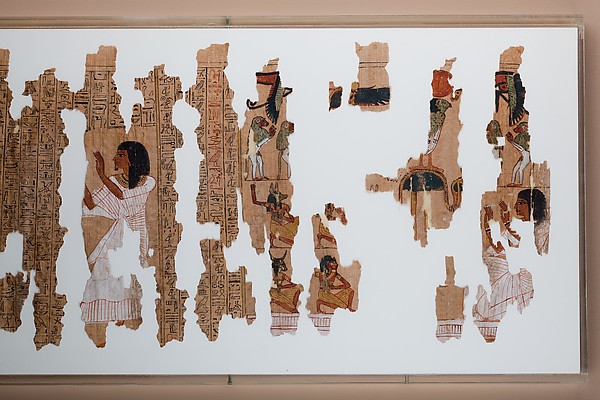
[img]http://images.metmuseum.org/CRDImages/eg/web-large/35.9.19a-e_EGDP010479.jpg [/img] December 6, 2012 at 10:16 pm #258804GuestThanks for the examples. FWIW, I really appreciate how cordial this board stays. I feel I can talk here as I would with my friends. Very different to most other boards. I’d probably take the ‘spiritual inspiration’ line more than any other. The papyrus could have been a ‘muse’ leading to deeper thinking.
I consider other things (e.g. Noah/Garden of Eden) to be no more than symbolic, so I suppose Joseph could have been inspired by the content of the scrolls and written what came to mind in response to the stimulus. I know that goes against the ‘literal translator’ that most have been taught, but it works for me, for now.
Parts of the temple endowment were probably lifted straight from masonry. But Joseph used them as symbols for something I consider more eternal and spiritual. Maybe it was a scene of mummification in Facsimile 1, but Joseph also saw the symbol of Abraham and his devotion to God even at the threat of his life.
December 7, 2012 at 1:31 am #258805Guest/Hate to interrupt a good conversation, but 
I really love the content, but I don’t see it as a literal translation of an actual historic record.
/Continue on you two
🙂 December 7, 2012 at 6:17 pm #258806GuestOld-Timer wrote:/Hate to interrupt a good conversation, but
I really love the content, but I don’t see it as a literal translation of an actual historic record.
/Continue on you two
🙂 Hi Ray, feel free to stay.
On the BoA I’m fine with either. A literal translation or a document that is inspired theological exploration.
I think it’s probably not a ‘documentary’ piece of work. Even if it’s a ‘literal translation’ I would imagine most of the stories are parabolic in nature.
I guess in saying that I’m partly side-stepping the issue. It must make critics mad when people like me just move the goalposts. They come up with what they consider hard proof and I just do a jelly-fish style reshaping of my perspective.
For what it’s worth, a lot of my ‘reframing’ started long before my faith crisis, so I don’t feel too irresponsible!
Emotionally I feel neutral about it. E.g., I will be genuinely gutted if the Book of Mormon is ‘inspired fiction’ – I want to meet some of the writers. But I don’t mind if the BoA is a history or a parable.
December 9, 2012 at 6:56 am #258807GuestGood discussion. I am weary of the years trying to convince myself that somewhere in an ordinary funerary document, there was a writing by Abraham that, doggonit…somehow got lost. After that didn’t work, it was trying to convince myself that it was just a catalyst that was somehow needed to bring forth much-needed scripture. That’s pretty much fizzed out too.
As I grow older and, hopefully, a little wiser…it gets harder to pretend.
As far as the BOM being inspired fiction….I passed the fiction part and am grasping for a few straws of the inspired part.
December 12, 2012 at 3:15 pm #258808GuestThe BoM stands up much better for me. Despite all the problems, it shows a sophistication lacking in the BoA, and some genuine mysteries. I also don’t like the BoA much because it is partly responsible for racism in the church.
As far as I’m concerned, the Book of Abraham started to be dubious as soon as someone translated the Rosetta Stone.
January 5, 2013 at 4:36 am #258809GuestHello all, My first post on what is probably my favorite LDS subject. Usually I find that people are either tired of talking about the subject or completely uninterested, so it is nice to see some interest in it. I hope that I am not intruding and that what I have to say is of interest.
A few observations if I may.
1. The claim that Facsimile#1 is unique is, in my opinion, not really relevant. Since each copy of this scene was hand drawn, even direct copies were not identical in every detail, variation is actually the norm. The areas that Joseph Smith recreated are problematic to what one would expect to find in similar Lion couch scenes. Probably the most difficult aspect of Joseph’s recreation is the knife. Since Anibus (the dark figure with the knife) is there to help the Osiris (Hor deified laying on the Lion couch) come back to life, there is no reason for him to be holding a knife. This would not be just a unique scene, it would be contrary to what one would expect to be buried with a Priest from the an Egyptian cult.
2. In Facsimile #3 we can find some of the few extant examples where we have both the text from which Joseph Smith is translating and how he interprets it. We know exactly which
texthe is trying to translate. 3. Facsimiles #1 & #3 are agreed upon by both critics and apologist as being at the beginning and end of the Hor scroll. For a book of Breathing this was not unusual though in the case of the Hor scroll the normal location of Facsimiles#1 & #3 are reversed. The starting and ending points of the scroll is important when considering the length of the scroll because it is possible to determine the uppermost outside diameter of the scroll by measuring damage on the first (Facsimile#1) part of the scroll. Both critics and apologists agree that the diameter of the Hor scroll could not be more than 1 & 1/4″ to 1 & 1/3″ in diameter. (That is about the diameter of an empty toilet paper roll.) This diameter limits that absolute length that the scroll could be.
4. Even though there are missing portions of the facsimiles it does not mean the critics are guessing Joseph Smith went wrong in recreating them. Any time the Joseph Smith versions of the restored facsimiles are shown to Egyptologist they are able to identify those areas that he recreated as opposed to the original undamaged areas. It is not just a question of guessing what was there in the missing portions, but that the recreations themselves are done incorrectly. (Upside down text, hieratic vs hieroglyphics in the wrong spot and so on.)
There are so many other issues and it is such an interesting subject.
January 8, 2013 at 3:28 am #258810GuestFence Sitter Thanks for your input. I started the thread so I could hear dialog like you posted. I am very uneducated in this matter. I was quite shocked a couple of months ago when I stumbled across this subject as I prepared for a sacrament talk. In fact this is the subject that “broke my shelf” and made it ok for me to acknowledge all of the questions and concerns I had been building over the years….kind of funny to think my faith crisis began with preparing a sacrament talk
Sent from my SAMSUNG-SGH-I727 using Tapatalk 2
January 8, 2013 at 4:49 am #258811Guestjohnh wrote:….kind of funny to think my faith crisis began with preparing a sacrament talk
Kind of sad. Many on here have similar starts. If only there was a better way…
Sent from my SGH-T889 using Tapatalk 2
January 8, 2013 at 5:57 am #258812GuestQuote:There is no (better) way.
Sorry, couldn’t resist. I don’t get to be the voice of Lucifer very often.
😆 :silent: In all seriousness, though, what is simply is. I have come to believe that those who are going to experience a crisis of faith are going to experience a crisis of faith – and that it’s not so much the “how” as it is the “so now what”.
I don’t believe any of us have much, if any, control over the “how” or even the “when” – but we do have more control over the “so now what”. That is true, at least, of those who find some kind of support, whatever that is, before they act rashly and do what they would not do if they slowed down, breathed deeply and learned to “be still” as they moved forward more intentionally and with chosen direction and purpose.
-
AuthorPosts


- You must be logged in to reply to this topic.