Home Page › Forums › History and Doctrine Discussions › The Church and Freemasonry
- This topic is empty.
-
AuthorPosts
-
April 25, 2021 at 5:22 pm #328299
Anonymous
Guestnibbler wrote:
My frame of reference could be off-base but I find it interesting how the Book of Mormon includes some themes that run parallel to the concerns of the Anti-Masonic Party; a party formed shortly after the 1826 disappearance of William Morgan from a town about 50 miles from Palmyra. Then just 12 years after the publication of the Book of Mormon Joseph founds a Freemason lodge in Nauvoo.That’s quite a turnaround.
The Lodge in Nauvoo was actually chartered/founded by Grand Master Abraham Jonas of the Grand Lodge AF&AM of Illinois. Joseph was not one of the petitioners who asked to have a Lodge in Nauvoo;
those recorded- George Miller
- Hyrum Smith
- William [Tannausdale?]
- Joshua Smith
- N. K. Whitney
- William [Fellham?]
- Austin Cowles
- L. N. Scovil
- Charles Allen
- John Smith
- Lyman Leonard
- Hiram Clark
- Samuel Rolfe
- David Pettegreen
- Christopher Williams
- John Patten
- John C. Bennet, and
- Heber C. Kimball
In fact, Joseph couldn’t have petitioned for Nauvoo Lodge UD because it was established before he became a Mason, and only Masons can petition for a lodge to be established.
April 26, 2021 at 9:32 am #328300Guestnibbler wrote:
My frame of reference could be off-base but I find it interesting how the Book of Mormon includes some themes that run parallel to the concerns of the Anti-Masonic Party; a party formed shortly after the 1826 disappearance of William Morgan from a town about 50 miles from Palmyra. Then just 12 years after the publication of the Book of Mormon Joseph founds a Freemason lodge in Nauvoo.That’s quite a turnaround.
Well, the original Book of Mormon condemns polygamy and priestcraft, while apparently teaching about the Trinity and a more traditional understanding of Heaven & Hell (without degrees of glory.)
Actually, come to think of it, were the Three Degrees – Telestial, Terrestrial and Celestial influenced by Masonry as well?
April 26, 2021 at 4:35 pm #328301GuestSamBee wrote:
Actually, come to think of it, were the Three Degrees – Telestial, Terrestrial and Celestial influenced by Masonry as well?
No. Joseph received revelations concerning the three degrees of glory as early as
February 1832In addition,
Freemasonry does not have a theologyApril 26, 2021 at 5:20 pm #328302Guestldt, One thing I wonder about is that D&C76, that you referenced, does not use the term “Degrees of Glory”… rather, it talks about the “Glory of the Telestial” and the “Telestial World”, etc.
I’ve wondered if the terminology of “degrees” might have come from Freemasonry, but of course, that’s just terminology, not theology. So I wouldn’t find it faith-shattering to find that JS used terms from FM to describe what he was trying to say.
One interesting tidbit (interesting to me, anyway) is that the D&C76 preface info, which was a 20th Century addition, uses the phrase, “degree of salvation”, even though D&C76 does not.
April 26, 2021 at 6:24 pm #328303GuestOn Own Now wrote:
One thing I wonder about is that D&C76, that you referenced, does not use the term “Degrees of Glory”… rather, it talks about the “Glory of the Telestial” and the “Telestial World”, etc.
Sure enough, you are right. It looks like the term
degreewas not used in any canonized scripture to refer to the Kingdoms of Heaven until D&C 131 was received in May 1843, over a year after Joseph became a Mason. I also cannot find any primary sources of Joseph using the term degreeoutside of the Church’s doctrinal canon prior to his Masonic initiation. After he became a Mason, he likely would have heard the term
degreefar more often after being made a Mason than before; it’s possible, then, that, being more accustomed to this term, he decided to use it to refer to the different Kingdoms of Heaven. SamBee wrote:
Actually, come to think of it, were the Three Degrees – Telestial, Terrestrial and Celestial influenced by Masonry as well?
In the context of the term
degreebeing used, it appears that you may have been right. I lounge corrected. 🙂 However, the concept itself of the different levels or Kingdoms of Heaven does not come from Masonry.
April 29, 2021 at 12:17 am #328304GuestI have experienced both the Temple ceremony and the three degrees of Freemasonry. I have found both to be beautiful in their own way. When a Masonic degree is performed, and those involved are experienced, it is moving. Kipling gave us all some of the most excellent writing in regards to Freemasonry. Poems, essays, novels were vehicles Kipling used to write about Masonry. The Man Who Would be King and Kim are probably his most recognized. Short stories like, “In the Interest of the Brethren”, and poems such as ” Banquet Night”, present Freemasonry directly. In one short story Kipling describes the lodge as being frequented by Christians, Muslims, and Hindus. So prevalent was Freemasonry in the English military Kipling wrote for some soldiers it was their religion, meetings being their only access to scripture. Kipling knew Masonry was not a religion, but for some it became religion.
Early America was very influenced by Masons. From Benjamin Franklin to John Paul Jones, American leadership was weighted by Masons. It has been told to me, revolution or no revolution, that Colonials and the English would meet during downtime to hold meetings.
George Washington was by far the most famous of Masons. And still is. Contrary to the “Washington Hypothesis” Washington did spend a lot of time in his church. He did spend a lot of time in lodge. There is a long line of Masonic lineage in US presidents.
As stated above there is nothing remotely satanic in the Masonic lodge. Nor “secret”. Again as stated above dates and times for meetings are posted. Masons are often prominent in their communities. They wear rings or other jewelry/clothes saying to the world: I am a Mason! If people get that curious I imagine you watch the degrees on YouTube.
Unfortunately most people who are not Masons get their information from the History Channel. The conspiracies they try to tie to the Masons is a hoot. The History Channel’s take on the Masonic Lodge ranks up there with Animal Planet’s shows on mermaids and the megalodon. Or Sy Fy’s Sharknado.
Long post, sorry.
April 29, 2021 at 9:18 am #328305GuestOver43 wrote:
Kipling knew Masonry was not a religion, but for some it became religion.
There are definitely quasi-religious aspects to it, from the symbolism to the nature of the ceremonies. Much of the symbolism has obvious parallels to other religions, with a masonic twist.
Quote:
Nor “secret”. Again as stated above dates and times for meetings are posted. Masons are often prominent in their communities. They wear rings or other jewelry/clothes saying to the world: I am a Mason! If people get that curious I imagine you watch the degrees on YouTube.
Well, we know about the Pentagon, Langley and that place in London James Bond works out of. People from these organizations have written books and given talks. But they are still secret in what they do.
You’re right, in one sense they do publicise themselves but that was not always so. They have also repeatedly been exposed, from the likes of Tolstoy to Stephen Knight etc that many of their symbols are out in the open.
It is “sacred not secret” all over again. There is basic masonry which many people are aware of, but also a whole bunch of other ceremonies that are not well known and little described if at all, since hardly anyone ever gets raised to that level
But there are still things many of the public would be uncomfortable with. Not all masons do these things. Some of these include drinking out of skulls, being lightly branded with a pentagram, having a dagger pointed at you etc. Even in the first degree (and in the old pre-1990 endowment) you are told your throat would be slit and you could be disembowelled if you exposed these things which are supposedly not secret.
The Masons have very strange offspring. On the one hand, you have the Shriners and the Buffalos (and a number of other minor fraternities which have become extinct) – these tend to be unobjectionable in most ways. Then at the other end, you have the likes of the KKK and Orange Order (whose black and purple preceptories are more obviously Masonic). The object of the last two organisations is to harass. The picture below is of Orange banners (which are paraded in public through Roman Catholic areas in Northern Ireland)
Two very big extremes – Shriners at one end, Klan at the other. I like to think the LDS are more towards the Shriner end when it comes to Masonic offspring, but we have excluded blacks and included brutal penalties within living memory. (I’d suggest many frats are in between, but some such as Yale’s Skull and Bones have wielded undue influence in American politics.) I’d suggest the LDS are in a similar portion of this spectrum to the Elks maybe.
See how many symbols you can recognise from these Orange banners.
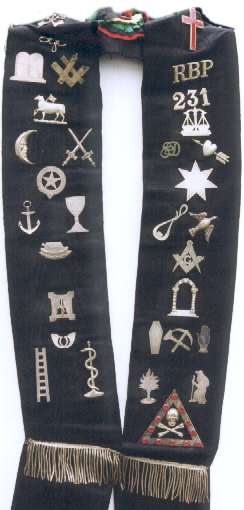
[img]https://christian-restoration.com/fmasonry/images/sash%20symbols.jpg [/img] My answer (from an LDS POV): The square and compasses (albeit modified); Sun, Moon and Star; all seeing eye (to be seen ?formerly on SLC Temple); pillars (but disguised in modern Temples); the pentagram; and possibly the triangle.
One thing which is missing is the bee or beehive. Widely used in both traditions as a symbol.
The serpent wrapped around a stick can be found on the WHO logo we have seen so much of recently but I have not seen it in LDS use. Depending on your take this – a medical symbol dating back to ancient Greece; the serpent raised in the wilderness; the serpent in the garden or the Kundalini serpent which in Indian belief is wrapped around the spine. Some people say it comes from a practice of removing worms by wrapping them round sticks.
May 3, 2021 at 7:44 pm #328306GuestThank you answering all my questions. I think I have a pretty good idea how a believing latter day saint can also be a Freemason and separate out each of them internally! May 3, 2021 at 8:15 pm #328307GuestRoy wrote:
Thank you answering all my questions. I think I have a pretty good idea how a believing latter day saint can also be a Freemason and separate out each of them internally!
My pleasure!
-
AuthorPosts
- You must be logged in to reply to this topic.