Home Page › Forums › History and Doctrine Discussions › The KJV Bible Sucks [I repented of this]
- This topic is empty.
-
AuthorPosts
-
November 8, 2013 at 7:18 pm #276290
Anonymous
GuestHere’s a little information about some various translations.
Quote:You can separate modern Bible translations into two basic groups—formal equivalency and dynamic equivalency. Formal equivalency attempts a word for word rendition, providing as literal a translation as possible. Dynamic equivalency is more like a paraphrase, trying to convey ideas thought by thought…
The most popular dynamic-equivalency translations, which dominate the evangelical world, are the New International Version (NIV), Today’s New International Version (TNIV), The Message (MSG), The Living Bible (TLB), the Good News Bible (GNB), and the New Living Translation (NLT). Of those, the NIV is the most reliable…
The four most popular formal equivalency translations in English are the King James Version (KJV), the New King James Version (NKJV), the New American Standard Bible (NASB), and the English Standard Version (ESV).
(
http://www.bible-researcher.com/versbib10.html )
Some translations are a combination of those two methods.I wrote before that “I mostly like the NIV,” but I guess I really don’t. It was modernized and dumbed-down a bit too much. The NLT was dumbed-down way too much. I like the ESV, which is a revision of the RSV, which is a revision of the ASV, which is based on the ERV, which is a revision of the KJV. Here’s information about this line of translations:
Quote:English Revised Version (RV or ERV), 1881: “a late 19th-century British revision of the King James Version of 1611. It was the first and remains the only officially authorized and recognized revision of the King James Bible. The work was entrusted to over 50 scholars from various denominations in Britain. American scholars were invited to cooperate, by correspondence… Their stated aim was ‘to adapt King James’ version to the present state of the English language without changing the idiom and vocabulary,’ and ‘to adapt it to the present standard of Biblical scholarship.’ Further, it was to be ‘the best version possible in the nineteenth century, as King James’ version was the best which could be made in the seventeenth century.’ To those ends, the Greek text that was used to translate the New Testament was believed by some to be of higher reliability than the Textus Receptus used for the KJV” ( http://en.wikipedia.org/wiki/Revised_Version ).American Standard Version (ASV), 1901: “rooted in the work that was done with the Revised Version (RV). In 1870, an invitation was extended to American religious leaders for scholars to work on the RV project. A year later, 30 scholars were chosen by Philip Schaff. The denominations represented were the Baptist, Congregationalist, Dutch Reformed, Friends, Methodist, Episcopal, Presbyterian, Protestant Episcopal, and Unitarian… Because the language of the ASV was limited to Elizabethan English, as well as because of what some perceived to be its excessive literalism, it never achieved wide popularity” ( http://en.wikipedia.org/wiki/American_Standard_Version ).Revised Standard Version (RSV), 1952, 1971: “a revision of the American Standard Version (ASV) authorized by the copyright holder. The RSV posed the first serious challenge to the popularity of the King James Version (KJV). It was intended to be a readable and literally accurate modern English translation. The intention was not only to create a clearer version of the Bible for the English-speaking church but also to ‘preserve all that is best in the English Bible as it has been known and used through the centuries’ and ‘to put the message of the Bible in simple, enduring words that are worthy to stand in the great Tyndale-King James tradition’” ( http://en.wikipedia.org/wiki/Revised_Standard_Version ).New American Standard Bible (NASB), 1971, 1995: “a scholarly update of the 1901 American Standard Version. Sponsored by the Lockman Foundation, the translators used the best available Greek and Hebrew texts as a guide” (1). “It is a literal translation from the Hebrew and Greek languages that incorporates the scholarship of several centuries of textual criticism conducted since the original KJV. It quickly became a favorite translation for serious Bible study” (2).
New Revised Standard Version Bible (NRSV), 1989: published by The National Council of Churches in 1989, is an update of the highly regarded Revised Standard Version of 1952. The language is very modern, but the style is more traditional than the NIV. The NRSV uses gender-inclusive language in places where it would have been understood that way in the original language (1). English Standard Version (ESV), 2001, 2007, 2011: A revision of the RSV. “The ESV is the most recent translation, which stands firmly in the formal equivalency tradition. It is a very solid translation in updated language that aims to reproduce the beauty of the KJV. The result is one of the most poetic and beautifully structured versions that maintains a high degree of accuracy and faithfulness to the original languages” (2). “The stated intent of the translators was to follow an ‘essentially literal’ translation philosophy while taking into account differences of grammar, syntax, and idiom between current literary English and the original languages’” (
http://en.wikipedia.org/wiki/English_Standard_Version ).1.
http://www.christianbiblereference.org/faq_kjv.htm 2.
http://www.gty.org/resources/Questions/QA167/Which-Bible-translation-is-best
And some others:
Quote:New International Version (NIV), 1978, 1984, 2011: “a completely new translation of ancient Greek and Hebrew texts sponsored by the New York International Bible Society, was published in 1978. Its clear, direct modern English makes it easy to read and understand” (1). “Its translators did not attempt to translate strictly word for word, but aimed more for equivalent ideas. As a result, the NIV doesn’t follow the exact wording of the original Greek and Hebrew texts as closely as the King James Version and New American Standard Bible versions do. Nevertheless, it can be considered a faithful translation of the original texts, and its lucid readability makes it quite popular, especially for devotional reading” (2).
The Living Bible (TLB), 1971: “a popular paraphrased version written by Kenneth N. Taylor, who began this version to help his own children understand the New Testament Letters of Paul” (1). New Living Translation (NLT), 1996: “a thought-by-thought translation by 90 Bible scholars from various theological backgrounds and denominations. It is similar to The Living Bible, but the language is more traditional” (1). New English Translation (NET Bible), 2005: “a free, ‘completely new’ on-line English translation of the Bible, ‘with 60,932 translators’ notes’ sponsored by the Biblical Studies Foundation and published by Biblical Studies Press…a completely new translation of the Bible, not an update or revision of an older one…The translation and extensive notes were undertaken by more than twenty biblical scholars who worked directly from the best currently available Hebrew, Aramaic, and Greek texts…The translation is most notable for an immense number of lengthy footnotes (which often explain its textual translation decision), its open translation process, its availability on the Internet (both during its beta process and in its final form), and its open copyright permitting free downloads” ( http://en.wikipedia.org/wiki/New_English_Translation )“Because the version was primarily designed to be an Internet resource, the editors have freedom to experiment with and revise the version as they may see fit…the method of translation used in the NET Bible in its present form (2006) is inconsistent, but in general it is less literal than the New International Version. The translators have for the most part employed a dynamic equivalence method, in which they have tried to use expressions in ‘common language.’ This method gives the version a simple and contemporary English style, which may be appreciated by some readers; but it does tend to degrade the accuracy of the translation.” (
http://www.bible-researcher.com/net.html )1.
http://www.christianbiblereference.org/faq_kjv.htm 2.
http://www.gty.org/resources/Questions/QA167/Which-Bible-translation-is-best November 8, 2013 at 7:23 pm #276291GuestI find it fascinating that people try to use whatever words make the most sense to them, personally, when they choose a translation of the Bible (even if that means they alter the meaning slightly or significantly from another translation), but they condemn Joseph Smith for using the religious language that was most familiar to him in the Book of Mormon. It always gives me a chuckle when I hear that argument. I understand there are plenty of other legitimate issues involved for people when it comes to the Book of Mormon, but the choice of language absolutely isn’t one of them.
November 8, 2013 at 9:54 pm #276292GuestDarkJedi wrote:Maybe it’s out there and I don’t know it, but it would seem with modern technology and linguistic skills that there could be an undertaking to newly translate all that we have from the ancient Greek, Hebrew, and Aramaic.
That kinda sounds like the New English Translation (NET Bible).net.bible.orgNovember 8, 2013 at 10:30 pm #276293GuestI don’t think it “sucks” at all. It is one of the greatest works of literature in the English language. In terms of influence upon English – including the colloquial variety – it is more influential than any other work. Even Shakespeare doesn’t come close, and he gave us many popular phrases. I have a book next door which details the large number of phrases which it has given us. Secondly, while KJV is archaic, it has more poetry and life in it than some of the dead an unmemorable later versions.
Thirdly, we really need a standard Bible to go back to and quote. The myriad translations are confusing when it comes to memorising verses. And the modern ones have their issues too. Some are tailored to RC doctrine (Jerusalem), Watchtower society (New World) and some water down references to homosexuality (NIV) to make themselves agree with certain opinions, and some use a much reduced vocabulary (Good News etc). Some are extremely ugly stylistically – Good News, New World, Scholars Version.
November 8, 2013 at 10:38 pm #276294GuestBefore you embark on another translation, consider that there is a version in English for every single year since the KJV was published. We really don’t need yet another one for that simple reason! I think it is far more important that the Bible is properly translated into certain languages which it hasn’t been yet. If nothing else, it will preserve those languages if they die out.
November 8, 2013 at 11:27 pm #276295GuestVery interesting topic post Shawn, thank you! I stumbled on an excellent Q&A session with Philip Barlow ( a Mormon professer whom likely many participants here would enjoy his nuanced beliefs) where he discusses many of the problems the church faces going forward the next two generations so closely tied to a version of the the Bible that will eventually be seen as arcane and “Amish-like” for those religions still using it 40 years down the road. The entire presentation is 1hr 20min. All of it really good. If your time is limited start at 1 hour mark where he starts taking questions from the audience. https://www.youtube.com/watch?v=yhyO5L5XvU4&feature=youtube_gdata_player November 9, 2013 at 2:45 am #276296GuestOne other group of English Bibles has escaped attention – Jewish translations. They often shed quite a different light on OT November 10, 2013 at 11:22 pm #276297GuestThis is a really interesting discussion here. My uncle told me this once and I’m never heard this before, but he said that there is a version of the Bible that actually says the actual year when Christ’s second coming to supposed to be. When I first heard it I was completely surprised. Tell me, has anyone here ever heard that before? November 10, 2013 at 11:59 pm #276298GuestNo, and if I did I would refuse to buy it – for multiple reasons, not the least of which is that I don’t believe an exact time ever was part of the original statements. Removing the ambiguity is beyond speculative and, for me, destroys the only power I find in the message of a Second Coming – that not knowing acts as a motivation to live every day as if it might be your last and that good will triumph in the end. That can be twisted, just like any other concept, but there is a lot of potential if it is applied productively and with meaning.
November 11, 2013 at 4:50 pm #276299GuestSamBee wrote:I don’t think it “sucks” at all. It is one of the greatest works of literature in the English language. In terms of influence upon English – including the colloquial variety – it is more influential than any other work. Even Shakespeare doesn’t come close, and he gave us many popular phrases. I have a book next door which details the large number of phrases which it has given us.
You got me thinking. The KJV Bible is a venerable and valuable work. I really am sorry for saying it sucks. I can be more respectful while advocating for the use of something new.
SamBee wrote:Secondly, while KJV is archaic, it has more poetry and life in it than some of the dead an unmemorable later versions.
I agree it is more poetic than some versions. More than the NIV and NLT, for example. Perhaps we won’t miss much of the poetry and life if we read the ESV.
SamBee wrote:Thirdly, we really need a standard Bible to go back to and quote. The myriad translations are confusing when it comes to memorising verses. And the modern ones have their issues too. Some are tailored to RC doctrine (Jerusalem), Watchtower society (New World) and some water down references to homosexuality (NIV) to make themselves agree with certain opinions, and some use a much reduced vocabulary (Good News etc). Some are extremely ugly stylistically – Good News, New World, Scholars Version.
I agree. It’s good for us to be on the same page. And we should use a bible that is as accurate and faithful as possible.
SamBee wrote:Before you embark on another translation, consider that there is a version in English for every single year since the KJV was published. We really don’t need yet another one for that simple reason!
I think it is far more important that the Bible is properly translated into certain languages which it hasn’t been yet. If nothing else, it will preserve those languages if they die out.
Yes, there are many, many translations. It seems that only a handful are significantly used, though. I’ll speak more about this later. Thanks for your input, SamBee.November 11, 2013 at 6:12 pm #276300GuestShawn wrote:Roy wrote:I believe that JS made changes to bible passages that were confusing and also to make some better fit into current LDS understanding. As a “Translation” it would be a very difficult sell. JS made changes that are not in the earliest manuscripts and didn’t make changes where the earliest manuscripts have changes.
Good points. But to whom would the translation be sold? Why would it need to be sold? It may be that some of the JST is good and some have been superseded. That’s okay. What I don’t like is incorporated it half-way.I compare it to the POGP. It is called a translation. In the case of the POGP we have at least part of the original source document and it doesn’t match up with the translation. In the case of the JST we have access to some of the early versions that weren’t available 200 years ago. These suggest that JS was not restoring the bible to the words/intent of the original authors in his “translation”. It suggests that he was changing verses that he didn’t agree with and that didn’t fit in with his understanding of things.
I have heard multiple times that the JST translation was to restore things that had been taken from the bible. This does not appear to be the case. I do not think that the church leaders would want to put the JST front and center. Better to keep it as a footnote.
November 11, 2013 at 7:49 pm #276301GuestI’ll re-summarize my thoughts and then let it go. 1. I don’t believe archaic language is
inherentlysacred and there is no compelling need to keep it in scriptures. 2. Many, many passages in the KJV are difficult to comprehend and this is not necessary.
3. The KJV includes many errors.
4. Some errors are addressed by the JST, but it is largely ignored.
5. I would like the COJCOLDS to adopt another standard or make a new translation. This would benefit many people.
We could use the English Standard Version (ESV), which maintains some aesthetic qualities. However, we may want to incorporate at least parts of the JST, and the publisher may not allow that. Also, the publisher may not allow the addition of our footnotes – we are the only church (besides break-offs) that refers to scriptures outside of the bible in the footnotes.
The KJV really does have content that is difficult to understand. How many LDS people really study the bible these days? I’d bet that a greater percentage of those on this forum have studied it in the last few years compared to the general LDS population. I believe more people would study it if it were easier to understand. I wish it would flow better as well. Breaking it up into columns and verses makes it harder to read. Adult converts especially will have a hard time transitioning to the KVJ if they are accustomed to the NIV or NLT. I think fewer and fewer LDS will want to read the KJV as time goes on.
Here is a small sample of verses to consider:
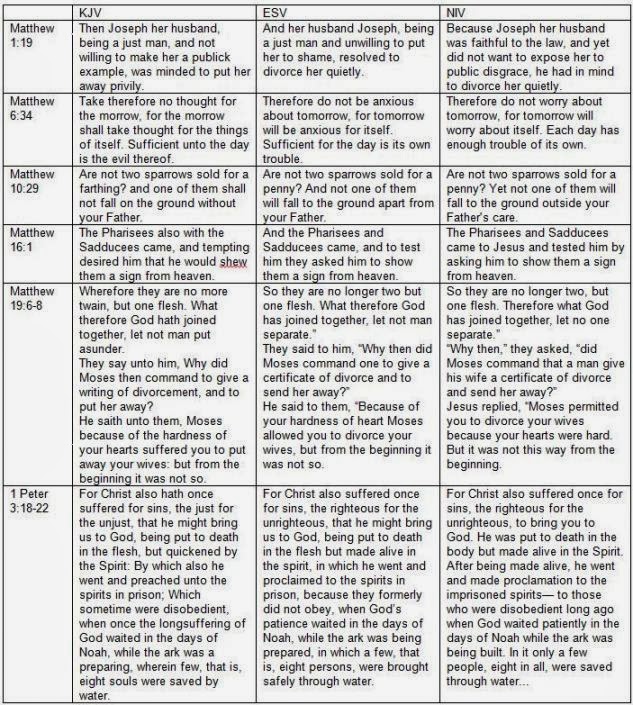
[img]http://3.bp.blogspot.com/-GVuMWWd2Z4o/UoE0CHtJFyI/AAAAAAAAAi0/cM8u2WIzOzo/s1600/verse.jpg [/img] I don’t see any way to make Matthew 6:34 in the KJV comprehendible. And check out Matt 16:1 – “and tempting desired him that…” What? And look at those verses in 1 Peter – “the ark was a preparing” and “eight souls were saved
bywater”??? [EDIT: I just read that “by water” is probably the correct translation, meaning “The same water which drowned the unbelieving, buoyed up the ark in which the eight were saved.” ( sourceThere are many, many more. It would really benefit many people to use something newer. If it is needful to create a new translation, then so be it. What’s right is right, regardless of how many translations already exist.
I’d glad to get this off my chest – it has been frustrating to me as I’ve carefully studied the books of Matthew, Mark, Luke, and John. I suppose I should chill out now
November 11, 2013 at 9:55 pm #276302GuestShawn, I can appreciate you say that it is not of practical contemporary use, and to an extent you’re right. However, I do feel that its difficulty is much exaggerated. Look at this – Quote:In the beginning God created the heaven and the earth.
2 And the earth was without form, and void; and darkness was upon the face of the deep. And the Spirit of God moved upon the face of the waters.
3 And God said, Let there be light: and there was light.
4 And God saw the light, that it was good: and God divided the light from the darkness.
5 And God called the light Day, and the darkness he called Night. And the evening and the morning were the first day.
6 And God said, Let there be a firmament in the midst of the waters, and let it divide the waters from the waters.
7 And God made the firmament, and divided the waters which were under the firmament from the waters which were above the firmament: and it was so.
8 And God called the firmament Heaven. And the evening and the morning were the second day.
9 And God said, Let the waters under the heaven be gathered together unto one place, and let the dry land appear: and it was so.
10 And God called the dry land Earth; and the gathering together of the waters called he Seas: and God saw that it was good.
The only word I think any of us would have any trouble with here is “firmament”. I have to go to my dictionary while reading modern novels, but most of the time with the KJV the difficult words at least recur. “Void” possibly, but “void” is still in common use in English especially in the phrase “null and void”.
Also, I think folk don’t flex their reading muscles as they should these days.
If there is a
practicalargument for the KJV, it’s that it’s a standard. I think it’s memorizing it. If everybody’s memorizing different versions, or if you read multiple versions it can be easy to muddle them. None of the other Bible translations have succeeded in becoming so universal. I’m going to put a vote in for the New English Version. No one’s mentioned it. it’s basically a British modern translation. It’s not for the style, which is uneven (sometimes great, and sometimes not so great), or even in the translation (which in the Stick of Ephraim bit agrees oddly with LDS doctrine), it’s for the layout. I’ve never seen a Bible so well laid out. KJV lacks in that department, but even that could be sorted out.
Here’s a page from the New English Version. My comments follow –

[img]https://www.logos.com/images/PageScans/24552pages/002/24552_002_05.jpg [/img] * Note verse numbers are in margin – really nice touch. Makes text flow more easily.
* Subheadings – common in many Bibles, but useful.
* Footnotes – one or two about, but not too cluttered as perhaps our version is. Although cross references are lacking.
* Note the judicious use of paragraphs, quoted speech, capitals etc.
* It’s really clear when verse appears (not so much on this page, but the psalms are well laid out.)
* Note use of italics. Again well thought out.
Where the NEB falls down is that the writing style is uneven, but as I hope I’ve shown, in visual organization it’s great.
November 11, 2013 at 10:09 pm #276303GuestQuote:I have heard multiple times that the JST translation was to restore things that had been taken from the bible. This does not appear to be the case. I do not think that the church leaders would want to put the JST front and center. Better to keep it as a footnote.
The JST is not a translation in my view, it is what is known as an amplified Bible. These are versions that seeks to expand on what is in the text, in order to make it clearer. Hebrew, in particular, can be very laconic, leading to much interpretation.
Quote:I’ll re-summarize my thoughts and then let it go.
1. I don’t believe archaic language is inherently sacred and there is no compelling need to keep it in scriptures.
2. Many, many passages in the KJV are difficult to comprehend and this is not necessary.
3. The KJV includes many errors.
4. Some errors are addressed by the JST, but it is largely ignored.
5. I would like the COJCOLDS to adopt another standard or make a new translation. This would benefit many people.
1 – I’ve no big fuss about thees and thous, but as you rightly point out, they are misinterpreted, even by GAs.
2 – I think this is much exaggerated. We can still understand the bulk of Shakespeare quite easily.
3 – They all do! Some of the modern ones are biased one way and another. Discoveries of new variants in text have not always resolved questions, but sometimes create more questions.
4 – Addressed above. It’s really an amplification, or paraphrase, IMHO.
5 – There’s a can of worms. If KJV goes, than that does raise some serious questions about our own latter-day scriptures that other churches don’t have.
Quote:How many LDS people really study the bible these days?
Funnily enough, quite a few. But which parts? Gospels and Revelation a lot. Leviticus and Deuteronomy – hardly ever!
November 11, 2013 at 10:59 pm #276304GuestJust as a point of reference: In one of the latest Pew Research Forum studies, the most Bible literate Christian denomination in the United States was . . .
The LDS Church
-
AuthorPosts
- You must be logged in to reply to this topic.