Home Page › Forums › Spiritual Stuff › What is worth believing in
- This topic is empty.
-
AuthorPosts
-
October 20, 2017 at 5:37 pm #211696
Anonymous
GuestThere is a video which was publish by Alain DeBotton’s organization “The School of Life”, called “Do We Have Free Will or Are We Predetermined?”I wonder if most gospel/religious/philosophical truths fit in this catagory. Are we saved by “grace” or “works”? Is there “justice” in the life to come, or is this life, unfairness and all, all that we get? Are families forever, or do we need to make the most of the finite time we have with them?
Truths are objective; Joseph Smith practiced polygammy. The world is round. Denying it is usually counter-productive. But lets take both of those absoulte truths in historical context. Emma Smith and her children were in absolute denial of Joseph Smith’s practice of polygammy. But what if accepting this absoulte truth would’ve caused irreparable bitterness and psychological damage to Emma? What if the husband Emma believed she had was a better man than the husband she actually had? Can we really say Emma was worse off for believing a lie?
And with earth being round, and undeniably not the center of the universe… back before astronomy and exploration, when man was weak and the world was filled with the unknown, isn’t there some value in believing that our world is large and of importance in this universe? Would our species have survived knowing it’s world is hardly more than a pale blue speck in an incomprehensibly vast universe? I believe there is empowerment in believing that our lives and world have some level of import and meaning, and having the world be “the center of it all” reinforces that belief. On the other hand, I think it can be very healthy to take more of a nihilistic approach, which the vastness of the universe seems to reinforce. When you don’t get that job promotion, when your children rebel, when you fall short of the person you would like to be, still be happy! In the long scheme, all of it matters very little. The morning sun’s rays glistening off the dew is ephemeral; but that’s what gives it beauty.
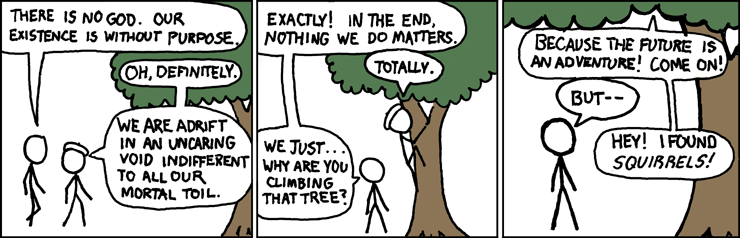
[img=https://imgs.xkcd.com/comics/nihilism.png][/img] I am reminded of a quote from the movie “Second-Hand Lions”. It’s part of Uncle Hub’s “Being a Man” speech.
Quote:Sometimes the things that may or may not be true are the things a man needs to believe in the most. That people are basically good; that honor, courage, and virtue mean everything; that power and money, money and power mean nothing; that good always triumphs over evil; and I want you to remember this, that love… true love never dies. You remember that, boy. You remember that. Doesn’t matter if it’s true or not. You see, a man should believe in those things, because those are the things worth believing in.
What do you think? Are lies sometimes worth believing in? Should we sometimes be willing to adjust our beliefs, not by what is objectively true, but by what we need to believe?
October 20, 2017 at 6:47 pm #324540GuestYou hit on a ton of different issues. Let me comment on a few. You broach the topic of external and internal locus of control. Are we in control, or is someone else in control?
Answer — both. We can definitely screw up our lives if we want to. At the same time, we are subject to the choices of others. If Kim Jon Un drops a bomb on America I don’t think I had much to do with that. I won’t blame myself. If I go into the office of my boss and start swearing at her, I hold myself responsible if I get disciplined. So, the healthy mind, in my view, views their circumstances as a blend of the results of personal choices and the decisions of others. Wisdom to know the difference is at the heart of peace.
Is it good to believe something even though it has no evidence of truth? I think it’s best to be agnostic about it and make the best choices you can in the situation. Most of the choices impact health, wealth and relationships. Make the best decisions you can for those three areas of your life, and hope for the best. There is comfort in reserving judgment on matters that are not provable, and that for me means agnosticism about matters that are not proveable or intuitively true.
October 20, 2017 at 9:48 pm #324541GuestI want to add that I think conclusions drawn from sound critical thinking are good to believe — from applying processes that lead to sound conclusions. Patterns learned from experience are also valuable. I do think spiritual impressions have a place, but they can’t always be trusted. In fact, they can really screw your happiness up. I like spirituality combined with rationality. That way lies better decisions…. Scriptures — well, I find that only the ones that are standalone and life-focused, generally, seem to have the most value. Throw in historical context I don’t understand, and situation specific interpretations, and it gets murky. Like “its better for one man to perish than an entire national dwindle in unbelief” isn’t much to go on in a society with clear laws, a justice system and lots of forensic science
 October 21, 2017 at 12:52 am #324542Guest
I think there are a lot of things that are true only if 1) you personally believe them, or 2) most people believe them. “I can do this.”
“We can do this.”
“Money has value.”
“We have a loving family.”
“Cheaters never prosper.”
“Donald Trump is president of the United States.”
“I have a choice.”
In a sense, we can make certain things true just by believing them and then acting on our beliefs. Where we get in trouble is in trying to do the same thing with objective truth.
October 21, 2017 at 10:07 pm #324543GuestDeep stuff – I like it. I did a post on this – actually 2
https://wheatandtares.org/2017/09/01/free-will/https://wheatandtares.org/2017/09/01/free-will/” class=”bbcode_url”> https://wheatandtares.org/2017/09/08/follow-up-to-free-will-post/ ” class=”bbcode_url”> https://wheatandtares.org/2017/09/08/follow-up-to-free-will-post/ On the second one I really found it interesting what Robert Sapolsky says.
Quote:I don’t believe there is freewill. I believe freewill is what we call biology that hasn’t been discovered yet.
But what I find to be a hugely daunting task is how you’re supposed to you live your life thinking that way and even me, I am willing to write down and print there is no free will and here’s why. At some critical juncture of some social interaction I act absolutely as if I believe there is freewill. […] It is a whole lot easier to operate with a notion of agency.
He has a point. If I say I have no freewill – My mind kind of says, “does not compute – decide what you want to do!” -
AuthorPosts
- You must be logged in to reply to this topic.